Hobbies and Interests on a Resume: When They Earn Space
Decide whether interests add relevant evidence to your resume, with examples that distinguish an activity from a useful contribution.
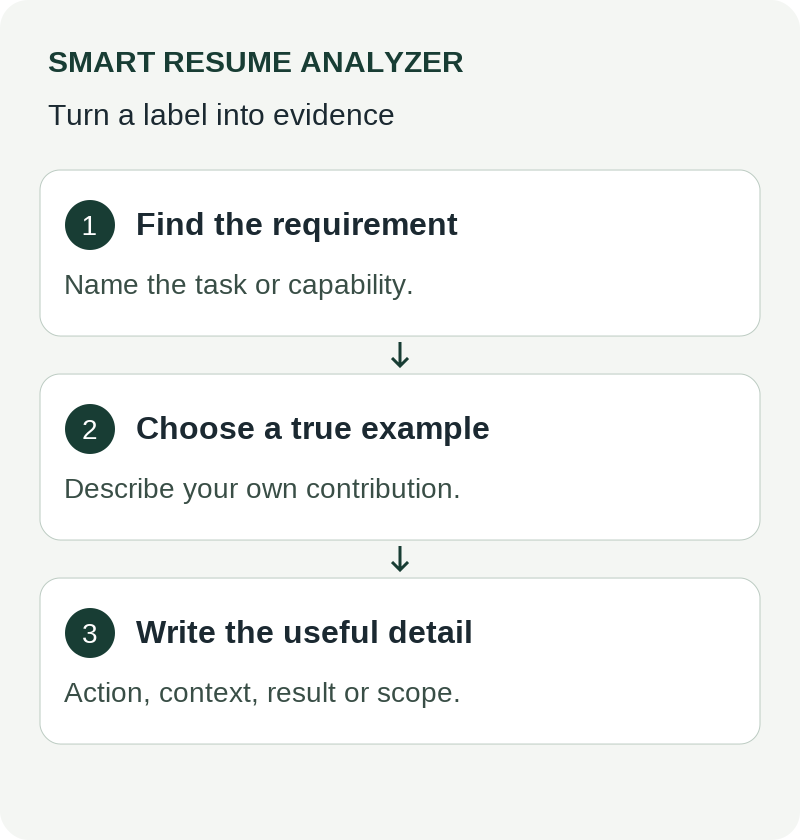
Hobbies are optional resume material. Include an interest when it adds relevant context you are comfortable discussing and does not displace stronger evidence. Leaving the section out is a valid choice; a resume does not need a personal-interest list to be complete.
Use a relevance test
Ask three questions: does the activity help explain something useful for this role, can I describe my own participation, and am I comfortable discussing it? If the answer to any of them is no, use the space elsewhere.
“Reading, music and travel” tells a reader little about your contribution. A specific activity may provide more context, but specificity is useful only when it remains truthful. An occasional activity should not become a leadership claim.
Compare three examples
| Draft entry | What is missing | A more useful treatment |
|---|---|---|
| Team sports | Your involvement and relevance | Usually omit, or name a real organizing responsibility |
| Photography | What you actually do | Mention a relevant portfolio if applying for visual work |
| Community gardening | The contribution | Describe coordinating a rota or maintaining records if true |
These examples are editorial illustrations, not rules about which interests employers prefer. Do not add a hobby because a list claims it guarantees that hiring teams will like you.
Move substantial work into experience
If you run a volunteer event, manage a club budget or maintain a community website, that may deserve an experience or project entry rather than a one-word hobby. Label it as unpaid or volunteer work and explain the task.
Fictional example: “Volunteer event coordinator, neighborhood repair club: maintained a monthly signup list, confirmed repair-station volunteers and shared equipment needs before each session.” The reader can understand the responsibility without needing to share the interest.
Protect your privacy
You choose what personal information to disclose. Avoid using an optional section to reveal details you would rather keep private, and do not list sensitive information about other participants. A public resume may circulate beyond the employer you first send it to.
Decide what to remove
When editing an experienced resume, compare an interest with the weakest relevant achievement you would otherwise omit. The achievement may be the better use of space. For an early-career applicant with a short work history, a genuine activity can help explain experience, but padding is still unnecessary.
Before submitting, make sure every retained entry is current enough to discuss. If the activity only survives because the template has a hobbies heading, delete the heading and simplify the document.
Sources and next step
Harvard career services: resume preparation resources
For substantial unpaid responsibilities, use volunteer experience on a resume.
Interests that earn their place
A hobby belongs on a resume when it supports the application. Examples include coding projects for a developer, a published blog for a writer, or competitive team sport for a role that values collaboration. A hobby also helps when it signals a skill the posting names, such as languages or public speaking, and you can speak about it.
How to write the line
Keep it to one short line or a few words under a heading such as "Interests". Be specific: "long-distance running, including [event]" is more informative than "sports". If you have a concrete result, such as a project or an event, say so briefly.
Why a short list usually beats a long one
Space on a resume is limited and every line competes with evidence of your work. A long list of interests can push stronger material off the page or make the resume look padded. If you have more than a line of relevant content, consider moving it into a "Projects" section where it can be described properly.
Interviewers may ask
Anything you list can come up in conversation. Include only what you are comfortable discussing for a few minutes, and avoid claims you could not support.
Final check
Review the section last, after you have fitted your experience, skills and education. If space is tight, remove it first. Then check that the file reads cleanly with the ATS parser and tailor the rest to a posting with resume job match.
Use These Tools Next
Use a working tool to apply this guidance to your own resume or job description.
Related Resume Pages
Explore related keyword and resume guidance pages to keep improving your application materials.
Using this guidance
Use these guides to check a specific part of your application. Automated feedback is guidance, not a hiring prediction. Check suggested edits against your own experience.
Related Articles
Continue with another guide on this topic.
Resume Writing
5 Common Mistakes To Avoid When Hiring A Resume Writer
Hiring the wrong resume writer can leave you with a generic, ATS-weak document that sounds better but still does not perform.
Career Development
Career Change Resume: How to Use an AI Resume Rewriter to Bridge the Skills Gap
Describe transferable experience in language relevant to your target role, while checking that rewritten bullets preserve the facts.
Executive Leadership
Executive Resume Writing: C-Suite Leadership Resume Mastery
Executive resumes should show business scope, transformation, and operating scale instead of reading like senior task lists.