CV Versus Resume: Which Document Does the Employer Want?
Understand CV and resume differences across academic and regional contexts. Choose sections and length from the role instructions rather than the label alone.
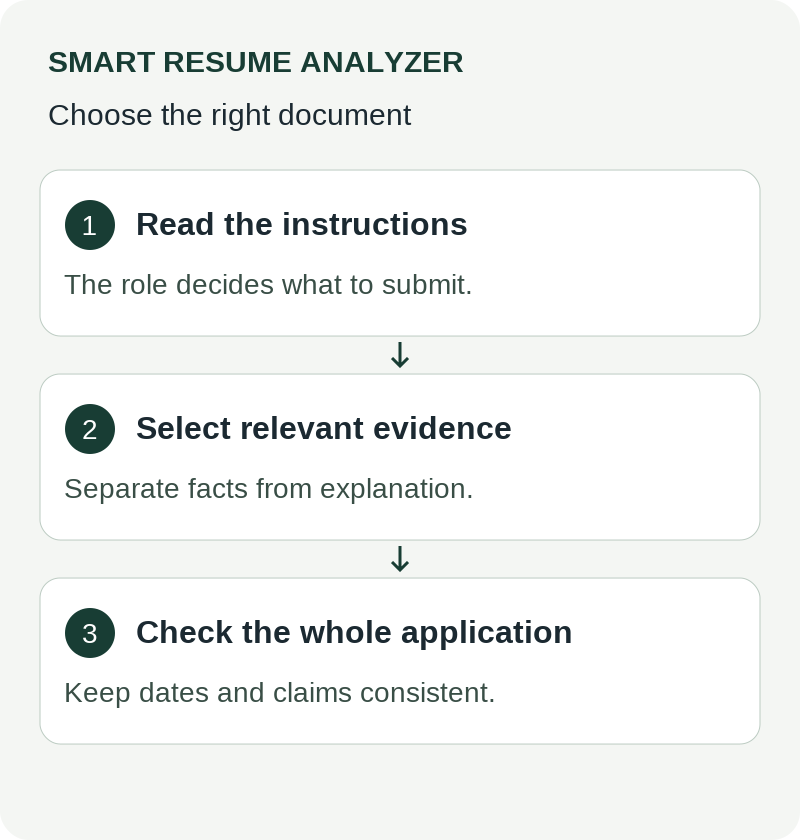
“CV” and “resume” do not mean exactly the same thing in every market. In US academic contexts, a CV often records a broader scholarly history, while a resume focuses on evidence relevant to a job. In some countries, “CV” is the ordinary term for the short employment document.
Check the context before the label
Read the vacancy and any application guidance. A UK employer asking for a CV may want a concise employment document rather than a list of every publication. A research position asking for an academic CV may need publications, teaching, grants, presentations, and other scholarly evidence.
| Context | Likely focus | What to verify |
|---|---|---|
| Nonacademic job application | Relevant skills and work history | Requested sections, length, and file type |
| Academic or research application | Scholarly work and credentials | Required categories and supplementary documents |
| International application | Local terminology and expectations | Employer instructions rather than country stereotypes |
These are context clues, not universal rules. The named employer or program is the best source for its own requirements.
Compare the evidence
A fictional software applicant might include a recent backend role, relevant projects, and technical skills in a targeted resume. A doctoral applicant might additionally need research appointments, publications, conference presentations, and teaching experience in an academic CV.
Do not expand a short job CV with irrelevant academic sections merely to make it look substantial. Likewise, do not remove requested scholarly detail from an academic application solely to force it onto one page.
Keep credentials precise
State the actual qualification and its status. Distinguish a completed degree from a program in progress, and an accepted publication from work submitted for review. Keep dates and institution names consistent across the document and application form.
Avoid adding photographs, personal identification numbers, family information, or sensitive details automatically because a generic international template includes them. Check what the specific employer requests and whether the material is necessary for the application.
Choose and test the file
Use the requested format and a clear filename. Preserve an editable version, then inspect the exported file for page breaks and readability. If the portal extracts information, review every autofilled field before submission.
For a standard employment document, use the simple resume template as an independent starting point. For academic examples, consult the official source below and adapt the structure to your discipline and the program's instructions. The document's label alone cannot establish the correct page count or content.
Sources and further reading
Use These Tools Next
Use a working tool to apply this guidance to your own resume or job description.
Related Resume Pages
Explore related keyword and resume guidance pages to keep improving your application materials.
Using this guidance
Use these guides to check a specific part of your application. Automated feedback is guidance, not a hiring prediction. Check suggested edits against your own experience.
Related Articles
Continue with another guide on this topic.
Career Development
Career Change Resume: How to Use an AI Resume Rewriter to Bridge the Skills Gap
Describe transferable experience in language relevant to your target role, while checking that rewritten bullets preserve the facts.
Resume Writing
Chronological vs Functional vs Hybrid Resume: Which Format to Use in 2026
Compare resume formats and choose a structure that makes your work history and relevant experience easy to follow.
Resume Writing
Contract Work on a Resume: Employer, Client and Project Boundaries
Explain contract and agency assignments clearly, identify the actual employer relationship, and separate client delivery from employment history.