Interview Questions and Answers: Build Your Own Evidence
Prepare answers to common interview questions with a role-specific evidence bank. Includes fictional examples, follow-up prompts, and rehearsal checks.
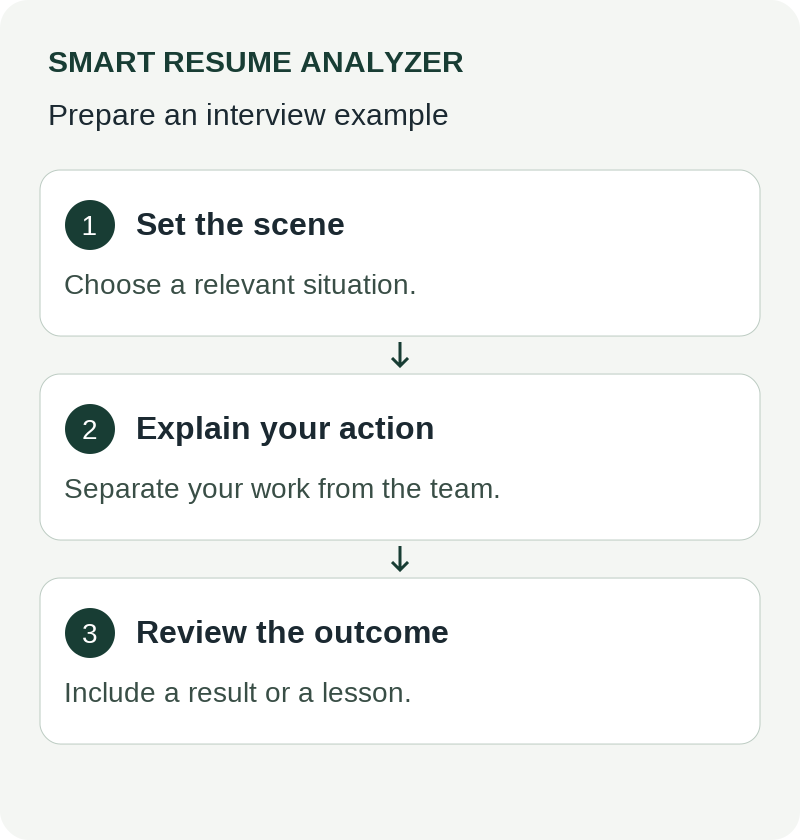
Interview preparation works best when you build a small bank of truthful examples rather than memorize generic answers. Questions vary by role, but interviewers often need to understand your background, decisions, collaboration, and motivation.
Prepare examples for the work
Read the responsibilities and select experiences that demonstrate relevant tasks. For each, record the setting, your contribution, the result or lesson, and what you would do differently. Mark hypothetical ideas clearly so you do not accidentally describe them as completed work.
| Common question | Evidence to prepare |
|---|---|
| Tell me about yourself | A focused professional introduction |
| Why this role? | A specific responsibility and your related experience |
| Describe a difficult situation | Your decisions, trade-offs, and outcome |
| Tell me about teamwork | Your own contribution within a shared effort |
| What are you developing? | A real limitation and an improvement process |
These are practice prompts, not a guaranteed list of questions an employer will use.
Illustrative answer: why this role?
“Your posting combines support coordination with knowledge-base maintenance. In my current role, I update handover notes and document recurring account issues. I am interested in a position where I can develop that work alongside a team with an established service process.”
The fictional answer connects actual responsibilities rather than praising an employer in vague terms. Replace the work and motivation with facts. If you have not done the exact task, identify the relevant experience and explain the gap honestly.
Illustrative answer: a difficult situation
“When two teams used different definitions for an account exception, I compared their weekly reports and documented the cases that did not agree. I brought the examples to both owners, and we agreed which definition to use for the next reporting cycle. I learned to confirm the reporting rules before assuming a difference was a data error.”
This fictional response describes action and learning without inventing a performance statistic. Be prepared for follow-ups about alternatives, who approved the change, and what your contribution involved.
Rehearse for a conversation
Say answers aloud, then ask a practice partner to interrupt with a follow-up. Shorten background that does not affect the decision. Avoid confidential details and keep dates consistent with your resume. For structured behavioral responses, use the STAR guide. Finish preparation by selecting questions for the interviewer that help you understand the actual work.
Sources and further reading
Use These Tools Next
Use a working tool to apply this guidance to your own resume or job description.
Related Resume Pages
Explore related keyword and resume guidance pages to keep improving your application materials.
Using this guidance
Use these guides to check a specific part of your application. Automated feedback is guidance, not a hiring prediction. Check suggested edits against your own experience.
Related Articles
Continue with another guide on this topic.
Interviews
Data Analyst Interview Questions & Answers
Data analyst technical interview questions and how to answer them — SQL, dashboards, statistics, and analysis scenarios with sample answers.
Interviews
DevOps Interview Questions & Answers
DevOps interview question bank with sample answers on CI/CD, cloud, containers, infrastructure as code, monitoring, and incident handling.
Interviews
QA Interview Questions: Worked Answers and Test Cases
Practice QA interviews with a password-reset test matrix, an API scenario, a complete defect report, and honest sample answers.