Resume Summary vs Objective: What Recruiters Actually Want in 2026
The debate between resume summaries and objectives has a clear answer in 2026. Here is what recruiters prefer, when each makes sense, and how to write a summary that actually helps.
Why the Debate Still Exists
The question of whether to use a resume summary or an objective statement has been answered and re-answered for decades - yet both formats still appear on resumes, and the advice given about them varies widely depending on which source you read.
The practical answer is simpler than most guides suggest. Understanding the difference, when each applies, and how to write whichever you choose is enough to handle this correctly.
What a Resume Objective Is
A resume objective states what you want from a job - your career goal and what type of role you are seeking. It is employer-directed from the candidate's perspective: "Seeking a project management role where I can apply my organizational skills in a collaborative team environment."
Objectives were standard in an era when most resumes were mailed or handed directly to employers. They communicated intent when context was limited.
What a Resume Summary Is
A professional summary states what you offer - your experience, skills, and the value you bring to an employer. It is reader-directed and employer-focused: "Operations manager with eight years in manufacturing environments, specializing in process improvement and lean implementation. Reduced line downtime by 18% across two facilities."
The summary leads with your capability, not your want.
What Recruiters Prefer in 2026
For most candidates with any meaningful work experience, a professional summary is significantly more useful to a recruiter than an objective statement. Here is why:
Recruiters scan for fit, not intent. A recruiter reading your resume needs to quickly answer: does this person have what the role requires? A summary answers that question in the first two lines. An objective tells the recruiter what you want, which is secondary information.
Objectives imply you are optimizing for yourself. "Seeking a role where I can grow" or "Looking for an opportunity to leverage my skills" centers your preferences. The summary centers your value to them.
ATS systems index the summary. The content at the top of your resume is typically parsed first and weighted heavily by ATS for keyword matching. A keyword-rich summary aligned to the role improves your ATS score more than an objective that does not contain role-relevant terms.
When an Objective Statement Still Makes Sense
Objective statements are appropriate in specific situations:
Entry-level candidates with no relevant experience. A recent graduate with limited work history may not have enough substance for a meaningful summary. An objective can signal the role type and field they are targeting when the work history cannot.
Career changers with a legitimate pivot to explain. A candidate moving from a different industry may benefit from briefly stating the transition context: "Transitioning from healthcare administration into operations management, bringing nine years of process documentation, compliance tracking, and cross-departmental coordination."
Highly targeted applications in unfamiliar contexts. Occasionally, stating your specific interest in a company or role type helps orient a recruiter who might otherwise be confused by your unconventional background.
Outside these situations, a professional summary is the stronger default.
How to Write a Summary That Actually Helps
A useful summary does three things in two to four lines:
- States what you do and at what level (job function + seniority)
- Provides your most relevant specialization or differentiator
- Includes one or two concrete signals of your scope or achievement
Avoid opening with your name, your degree, or self-described personality traits ("results-driven," "strategic thinker," "passionate professional"). These phrases are meaningless to a recruiter and waste the most-read space on your resume.
A strong summary for an ATS check: the summary section should contain terms from the target job description naturally embedded in a description of your actual background. This is the highest-leverage section for keyword alignment. Our resume job match tool shows which role-specific terms are absent from your resume - the summary is usually the right place to close gaps without forcing keywords awkwardly into bullet points.
Checking Your Summary Against the Role
After writing or updating your summary, paste the job description into our free resume checker alongside your resume. The keyword gap report will show whether your summary is doing the alignment work it should - or whether it is too generic to differentiate your application from the pile.
The summary is the first thing a recruiter reads and the last thing most candidates optimize. Getting it right is one of the highest-return improvements you can make to a resume.
Write an objective that names the work
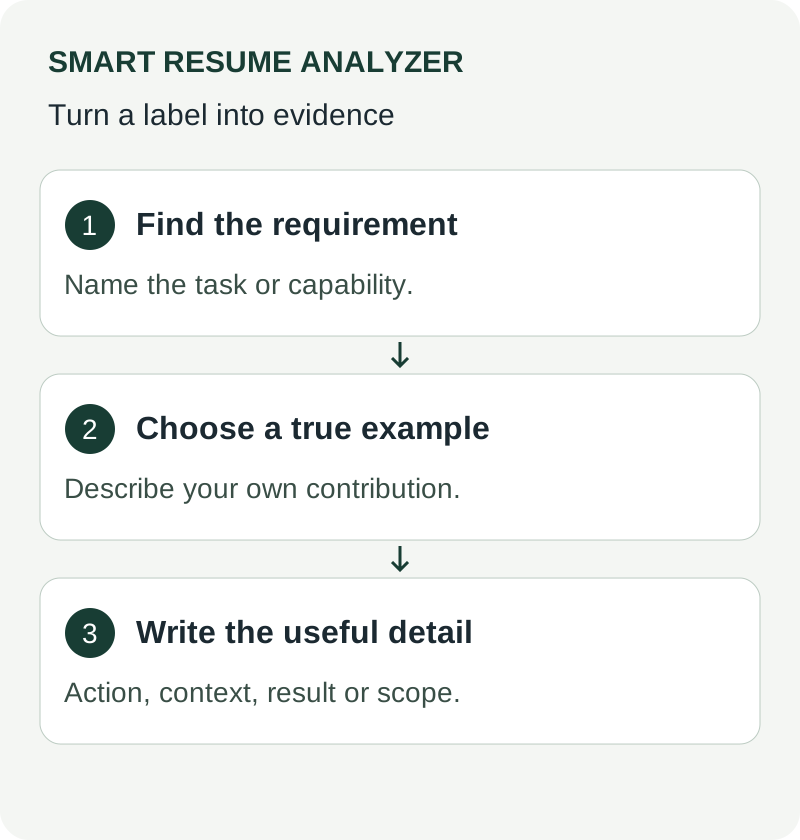
A fictional graduate objective might be: “Computing graduate seeking a junior QA role applying API testing and project documentation experience.” It identifies the direction and relevant preparation rather than saying only that the applicant wants growth. Use an objective when the transition needs clarification; omit it when the experience and application already make the direction obvious. Do not turn aspirations into claims of completed employment. Check that the named role matches this application.
Further guidance: CareerOneStop resume guide
Put the guidance into practice
Review resume summary rewrite suggestions. Use your own document and target role, and review suggested wording against your actual experience before applying.
Use These Tools Next
Use a working tool to apply this guidance to your own resume or job description.
Related Resume Pages
Explore related keyword and resume guidance pages to keep improving your application materials.
Using this guidance
Use these guides to check a specific part of your application. Automated feedback is guidance, not a hiring prediction. Check suggested edits against your own experience.
Related Articles
Continue with another guide on this topic.
Resume Writing
ATS Resume Keywords 2025: What Recruiters Actually Want (Free Checklist)
Modern resumes still win on clarity, role fit, and credible proof more than on trend-driven design changes.
Resume Writing
GitHub Profiles and Portfolio Links on Your Resume: What Recruiters Actually Check in 2026
Select relevant projects, explain your contributions, and make your GitHub or portfolio links easy to find and review.
Tool Guides
Compare Resume Versions Before You Apply: What Actually Improved?
Comparing resume versions helps you see what actually improved, what regressed, and which draft is stronger before you apply.