How to Structure an IT Resume Skills Section
Group technical skills by function, distinguish exposure from experience, and connect your strongest skills to projects and work.
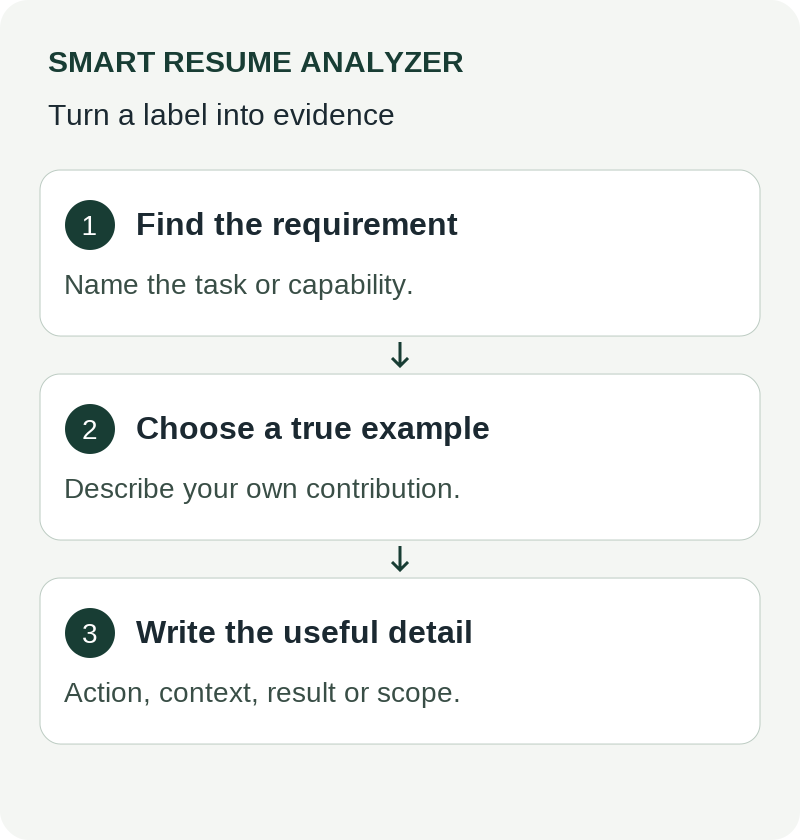
A useful technical skills section lets a reader locate the tools relevant to the role without working through an undifferentiated inventory. Its job is to summarize credible capabilities. Experience and project bullets supply the proof.
Choose groups that fit the job
For a backend application, a compact section might be:
- Languages: PHP, C#, TypeScript.
- Backend: Laravel, ASP.NET Core, Node.js, REST APIs.
- Data: PostgreSQL, SQL Server, Redis.
- Delivery: Docker, GitHub Actions, integration testing.
This is an illustrative structure, not a recommended stack for every applicant. A frontend candidate could instead use UI frameworks, browser fundamentals, testing, and accessibility. A data candidate might need querying, transformation, visualization, and statistical methods.
Put the most relevant group first. Remove tools you cannot discuss or use without substantial support. Keep acronyms alongside a full term where it helps comprehension, such as continuous integration and delivery (CI/CD).
Separate genuine skill gaps from wording gaps
Make three lists while reading the posting: skills you have used, skills with adjacent experience, and skills you have not used. Rename an existing skill only when the posting's wording is an accurate description. Experience with one cloud provider does not establish experience with another. A tutorial is not production ownership.
If a required technology is new to you, a clearly labelled project can demonstrate learning. “Built a deployment exercise using Terraform” is a defensible description. “Managed enterprise infrastructure” is not an appropriate rewrite of that exercise.
Replace proficiency graphics with context
Stars and percentage bars provide no common benchmark for competence. Use plain text and supporting evidence instead. “PostgreSQL: query optimization and migration work” tells a reader what you have done. Greenhouse documents graphics, columns, and text boxes as potential parsing problems, which is an additional reason to keep essential skills in ordinary document text.
Connect a skill to an outcome
Illustrative skill-only bullet: “Used Redis.”
Illustrative evidence: “Added Redis caching to the catalog endpoint and documented cache invalidation when product records changed.”
If you measured response time, specify the test conditions and result. Without measurements, describe the implemented behavior, affected scope, and verification. Do not invent a percentage to make a line look stronger.
Keep the list maintainable
Review the section for each role family rather than rewriting it from scratch for every posting. Backend, frontend, and platform variants can share a source document while presenting different relevant groups. Preserve the submitted version so that your interview preparation matches the application.
Before submitting, check that the exported document preserves the group labels and terms in the parser. Then use role keyword guides to check for missing terminology that genuinely describes your experience. A readable skills section supports review; it does not guarantee an ATS ranking or an interview.
Organising the section so it can be scanned
Group skills by purpose on separate lines, such as "Languages", "Frameworks", "Databases", "Cloud and infrastructure" and "Tools". A reader can find the area they care about quickly, and a keyword search can match each entry on its own line. A single run-on list of dozens of names is harder to read and to search.
Order by relevance
Put the skills the posting asks for first within each group, and drop tools you have only briefly touched. Honest depth beats breadth: a shorter list you can discuss is stronger than a long list you cannot.
Showing level without graphics
Skill bars and star ratings are images and carry no agreed meaning. If level matters, use words that mean something, such as "daily use" or "used on [project]", or let your experience bullets show depth. A skill with no evidence anywhere in the resume is worth questioning.
Keep it current
Review the section for every application. Remove outdated tools, add recent ones you can support, and use the names the posting uses where they describe the same thing, for example "PostgreSQL" rather than "Postgres" if the posting spells it that way.
Verify the output
Open the exported file and check that each group extracts as a clear line with the ATS parser. Then compare your terms with a real posting using resume job match and add only what you can truthfully claim.
Sources and further reading
Use These Tools Next
Use a working tool to apply this guidance to your own resume or job description.
Related Resume Pages
Explore related keyword and resume guidance pages to keep improving your application materials.
Using this guidance
Use these guides to check a specific part of your application. Automated feedback is guidance, not a hiring prediction. Check suggested edits against your own experience.
Related Articles
Continue with another guide on this topic.
Career Strategy
Skills-Based Hiring in 2026: How to Reframe Your Resume for Modern ATS
Skills-based hiring means employers care less about where you went to school and more about what you can actually do. Your resume should reflect that shift.
Resume Writing
5 Common Mistakes To Avoid When Hiring A Resume Writer
Hiring the wrong resume writer can leave you with a generic, ATS-weak document that sounds better but still does not perform.
Resume Writing
Choose Resume Action Verbs That Describe Your Contribution
Select accurate resume verbs for building, testing, analysis, coordination, documentation, and support, with examples that preserve your actual scope.