How to Answer “Tell Me About Yourself” in an Interview
Build a focused interview introduction from your current work, relevant evidence, and interest in the role. Includes graduate and career-change examples.
Answer “Tell me about yourself” with a professional introduction that helps the interviewer understand your fit for the role. Explain your current focus, one relevant experience, and why this opportunity is a sensible next step. You do not need to recite every job or disclose personal information.
Choose a useful structure
Use present, evidence, and direction as a planning framework. Start with what you do now or the work you are preparing to do. Add an example the interviewer can ask about. Finish with the connection to this role.
Practice a concise version, roughly a minute as a rehearsal target, and adjust to the prompt. That is not a universal interview time limit. If the interviewer asks for your background in detail, allow more context; if they request a brief introduction, shorten it.
Two fictional examples
Graduate: “I recently completed a computing degree and focused my final project on testing a booking API. I wrote checks for duplicate requests and documented how the team could run them. I am now looking for a junior QA role where I can build on that testing work and learn from an established release process.”
Career change: “I work in retail operations, where I coordinate stock handovers and help new colleagues follow our procedures. I have also been studying SQL and built a small inventory-reporting project. I am interested in this operations analyst role because it combines process knowledge with reporting, and I would like to develop that part of my work.”
These are examples of shape, not scripts to memorize. The second candidate distinguishes workplace experience from learning; it does not pretend the side project was a production analyst job.
Prepare for the follow-up
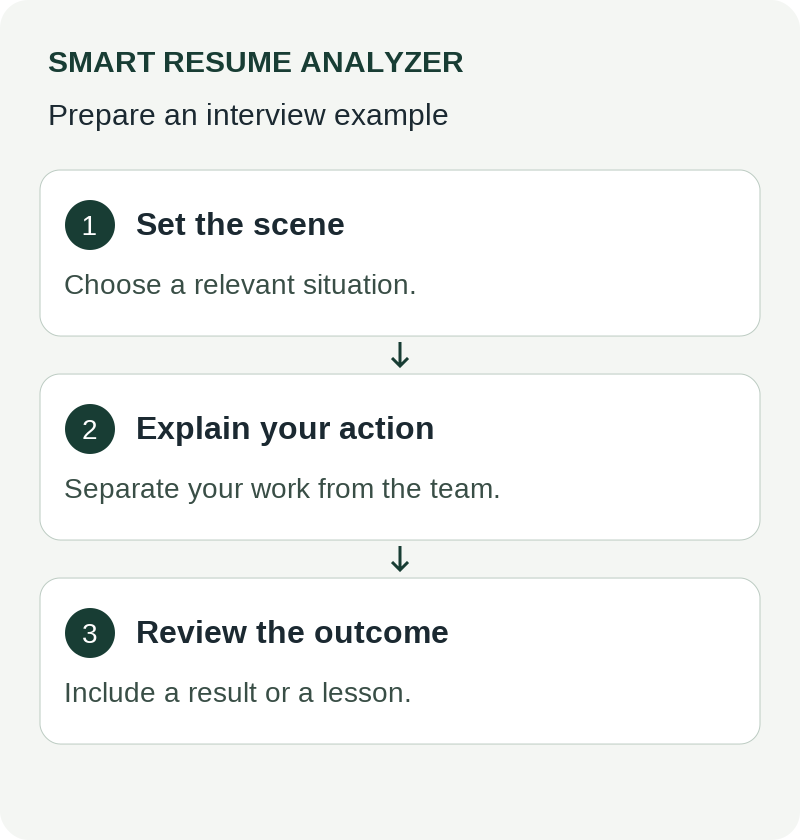
For each experience you mention, be ready to explain your contribution, the context, and the result or lesson. Avoid opening with a project you cannot discuss. If work is confidential, describe the type of problem and your role without exposing private data.
Record a practice answer or say it aloud to a trusted person. Remove jargon that would make sense only inside your current employer. Keep the connection to the advertised work visible rather than ending with a generic wish to “grow.”
Keep the answer consistent
Check titles, dates, and project scope against your resume. A practiced answer should sound natural and leave room for questions. Use the STAR guide when the interviewer moves from the introduction to a specific example of how you handled a situation.
What the question is really asking
"Tell me about yourself" is an invitation to explain, in under two minutes, why you are a good fit for this role. It is not a request for your life story. The interviewer wants a short account of what you do now, what you have done that is relevant, and why you are interested in this job.
A simple structure
Use present, past, future: describe your current role or focus, add one or two relevant achievements or experiences, and end with why this role is the next step. Keep each part to a few sentences, and practise saying it aloud until it sounds natural, not memorised.
Adjusting for your situation
- Early career: lead with your studies, projects and what you want to learn.
- Career changers: explain the transferable strengths, then the reason for the change.
- Returning after a break: state the break briefly and move to what you are ready to do.
Practice
Write your answer, time it, and trim anything that does not help the interviewer. Prepare a follow-up for each claim. The interview prep tool can generate practice questions from your resume, and you can check the resume itself with the ATS parser.
Sources and further reading
These pages are independent references for the advice in "How to Answer “Tell Me About Yourself” in an Interview". Read them alongside this guide and follow your target employer's own instructions where they differ.
Use These Tools Next
Use a working tool to apply this guidance to your own resume or job description.
Related Resume Pages
Explore related keyword and resume guidance pages to keep improving your application materials.
Using this guidance
Use these guides to check a specific part of your application. Automated feedback is guidance, not a hiring prediction. Check suggested edits against your own experience.
Related Articles
Continue with another guide on this topic.
Job Search Strategy
Preparing for a Recorded Video Interview
Preparing for a recorded video interview: read the instructions closely, build concise examples for camera, and ignore guesswork about AI scoring.
Tool Guides
How To Use An Apply Kit For Faster Cover Letters And Interview Prep
An apply kit connects resume analysis, cover letter drafting, and interview prep so your application workflow stays faster and more consistent.
Interviews
Behavioral Interview Answers: STAR, CAR & PAR
What is the STAR method? STAR stands for Situation, Task, Action, Result . It helps you answer behavioral interview questions with a clear story. Use STAR wh…