How to Write a Cover Letter That Doesn't Sound AI-Generated in 2026
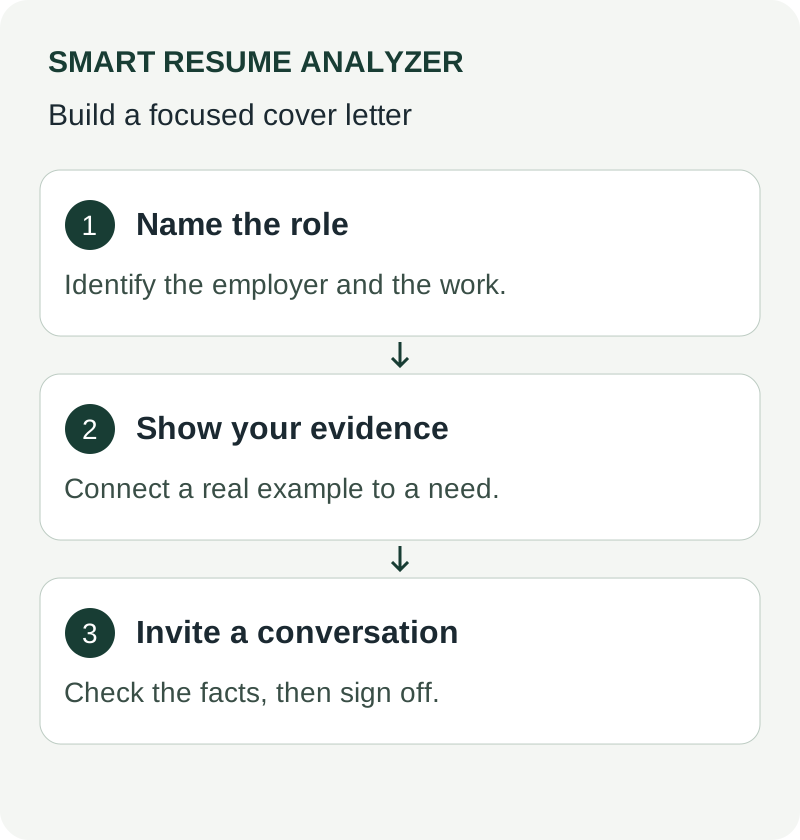
Replace generic wording with specific motivation and evidence from your work. Review AI-assisted drafts for accuracy and your own voice.
The Cover Letter Problem in 2026
AI writing tools have made cover letters faster to produce - and indistinguishable from each other. Recruiters report receiving cover letters that differ only in company name and role title, with identical structure, vocabulary, and even sentence rhythm.
The result: recruiters are skipping cover letters faster than ever, and some hiring teams have added AI-detection tools to their screening stack. A cover letter that reads as AI-generated is worse than no cover letter at all - it signals low effort and poor judgment.
But the problem is not AI assistance - it is generic output. The solution is not to stop using AI, but to use it differently.
What Makes a Cover Letter Sound AI-Generated
Generic opening paragraphs: "I am writing to express my interest in the [Role] position at [Company]. I believe my experience in [Field] makes me an excellent candidate." This opening, or any close variant, is the single most common pattern in AI-generated cover letters. Recruiters recognize it immediately.
Superlative self-description: Phrases like "passionate," "results-driven," "innovative," "dynamic team player," and "highly motivated" appear in AI output because they are statistically common in cover letter training data. They mean nothing specific.
Restatement of the resume: AI models default to summarizing the resume because they have nothing else to work from. A cover letter that lists your previous roles and skills in prose form adds no value.
Identical rhythm and structure: AI-generated cover letters tend to have three paragraphs of almost identical length with the same structural arc: why this company, what I bring, looking forward to discussing. When recruiters read 50 of these in sequence, the pattern is glaring.
The Cover Letter That Actually Works
The best cover letters in 2026 share three traits:
- They name something specific about the company or role that only someone who read the posting and researched the company would know
- They tell one story - not a summary of the resume, but a specific situation and outcome
- They are under 250 words - hiring managers spend under a minute on cover letters
Opening that doesn't read as AI
Forget "I am writing to express my interest." Start with the specific company or problem:
"Your Q2 case study on reducing first-response time for enterprise support tickets describes exactly the problem I spent two years solving at a similar scale."
"I've been following Acme's migration from a monolithic to a microservices architecture since you posted the retrospective in February - it's the same transition I led at my current company."
This opening signals genuine research and gives the recruiter a reason to keep reading.
The one story
Choose your single most relevant accomplishment. Give it depth:
- The situation and what made it hard
- What you specifically did (not "my team")
- The measurable result
This is the content AI cannot generate for you - because AI doesn't know your specific experience. This is where you replace the generic output.
The close
End with a confident, specific next step - not "I look forward to discussing my qualifications." Instead:
"I'd welcome the chance to talk through how I approached the conversion funnel work at my current role and whether the approach applies to your Q3 objectives."
How to Use AI as a Drafting Assistant (Correctly)
AI is useful for:
- Editing: Paste your draft and ask it to tighten language, fix grammar, and cut filler words
- Structure feedback: Ask whether your opening is specific or generic
- Synonym suggestions: When you are stuck on how to phrase something
AI is not useful for:
- Generating the specific story (only you know your experience)
- Knowing what is specific and distinctive about the company you are applying to (you have to research this yourself)
- Replacing the one personal touch that makes the letter worth reading
The cover letter that gets you noticed is 80% your specific experience and 20% AI editing. Not the other way around.
A strong cover letter works best paired with a resume that aligns tightly with the role. Use the free ATS checker to ensure your resume's keywords match the job description before you send - a compelling cover letter attached to a low-scoring resume still won't clear the ATS screen.
Use These Tools Next
Use a working tool to apply this guidance to your own resume or job description.
Related Resume Pages
Explore related keyword and resume guidance pages to keep improving your application materials.
Using this guidance
Use these guides to check a specific part of your application. Automated feedback is guidance, not a hiring prediction. Check suggested edits against your own experience.
Related Articles
Continue with another guide on this topic.
Job Applications
Cover Letter Mastery 2025: Write Compelling Letters That Get Interviews
A good cover letter in 2025 is short, specific, and built around the exact role instead of repeating the resume.
Cover Letters
Cover Letter Templates That Help You Apply Faster
Cover letter templates that help you apply faster, with a simple ATS-friendly structure you can tailor to any job in minutes.
Cover Letters
Sample CV Letter: How to Write One That Works
Learn what a sample CV letter should include, how to write one, and how to tailor every application with a cover letter builder.