Keywords to Describe Yourself: Replace Labels With Examples
Choose words to describe yourself in a resume or interview, then support each with evidence. Includes examples for teamwork, reliability, and initiative.
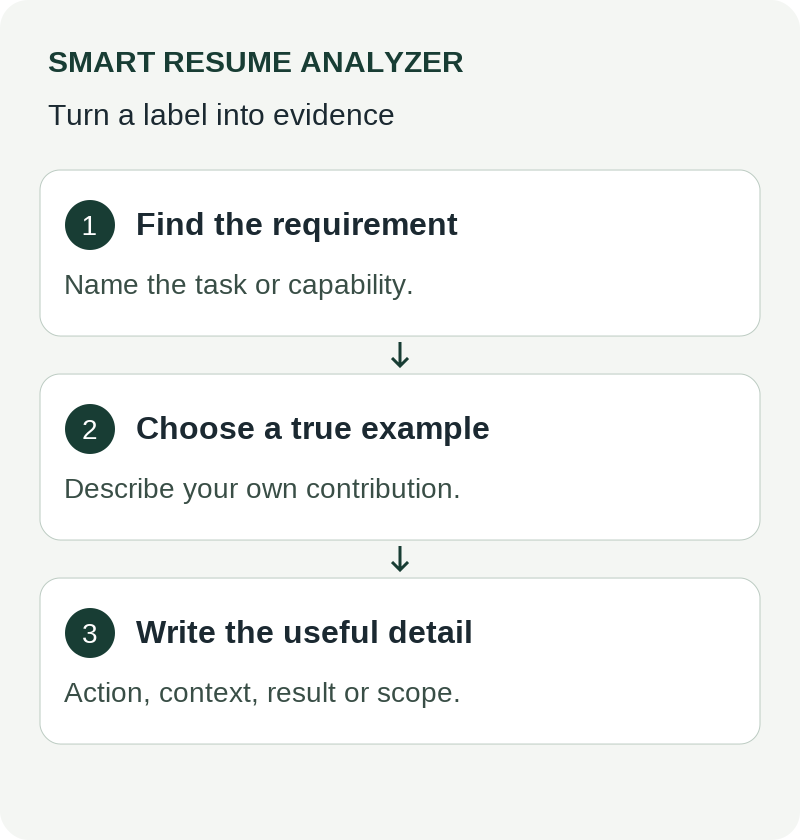
Words such as “reliable,” “analytical,” and “collaborative” can help describe you, but they become useful when a reader can connect them to something you did. Choose terms that fit the job and your experience rather than collecting adjectives from a generic list.
Start with the requirement
If a role asks for careful record keeping, an example of reconciling inconsistent records is stronger than an unsupported claim of perfection. If it asks for cross-team work, describe how you coordinated a handover or resolved a dependency. Job-description language helps identify relevant evidence; it is not permission to claim every listed skill.
| Word | Question to answer | Illustrative evidence |
|---|---|---|
| Reliable | What did others depend on? | Maintained the weekly release checklist |
| Analytical | What did you investigate? | Compared incident records to find a recurring cause |
| Collaborative | Who did you work with? | Coordinated the handover between support and finance |
| Adaptable | What changed? | Learned a replacement reporting workflow during a migration |
| Proactive | What did you initiate? | Drafted onboarding notes after noticing repeated questions |
These examples are fictional prompts. They are not results you should paste into your own resume unless the underlying work is true.
Write the evidence in the right format
On a resume, the action can stand on its own: “Maintained the weekly release checklist and confirmed ownership before deployment.” In an interview, add the setting and explain why the action mattered. In a short profile, combine one relevant descriptor with a concrete skill or responsibility.
Avoid strings such as “dynamic, passionate, hardworking team player.” They make the same broad claim without giving the employer a basis for comparison. Avoid medical or personality labels that reveal private information when a professional example would answer the question.
Check for overstatement
Ask whether a former teammate would recognize the example and whether you can describe your own contribution. Team achievements should not imply you did everything yourself. Keep confidential names and data out of the public document.
For technical skills, use the actual tool or method where appropriate. “SQL reporting” communicates something different from “analytical.” Use the job-description keyword guide to distinguish responsibilities, tools, credentials, and personal qualities before selecting wording.
Choosing words that carry meaning
Words like "motivated" and "hard-working" appear on most resumes and say little. Better descriptors are specific to the work, such as "analytical", "detail-oriented" or "collaborative", and are most convincing when backed by an example. Choose a few that match the posting and prove each in a bullet.
Turning a word into evidence
For each quality, write one sentence showing it in action: "Detail-oriented" becomes "Reconciled [number] accounts a month and found [type of discrepancy] before reporting". Use real details only.
Where to place them
Use two or three descriptors in your summary and let the bullets carry the proof. Avoid a standalone list of adjectives.
Check it
Compare your wording with a posting using the job description keyword finder and resume job match, and confirm the file extracts in order with the ATS parser.
Questions people ask
How many descriptive words should I use? Two or three in the summary is enough. More than that reads as a list, and the bullets should carry the proof.
Can I copy words from the posting? Use them where they honestly describe you, and back each with an example from your work.
Sources and further reading
Use These Tools Next
Use a working tool to apply this guidance to your own resume or job description.
Related Resume Pages
Explore related keyword and resume guidance pages to keep improving your application materials.
Using this guidance
Use these guides to check a specific part of your application. Automated feedback is guidance, not a hiring prediction. Check suggested edits against your own experience.
Related Articles
Continue with another guide on this topic.
Resume Writing
Data Analyst Resume Bullet Rewrites With Evidence
Rewrite data analyst resume bullets with SQL, reporting, and stakeholder examples. Show the business question and your contribution without inventing metrics.
Resume Writing
ATS Resume Keywords: What Recruiters Actually Want (Free Checklist)
Modern resumes still win on clarity, role fit, and credible proof more than on trend-driven design changes.
Resume Optimization
Resume Keywords Optimization Guide: Master ATS and Recruiter Appeal
Keyword optimization works when the right terms are placed in the right sections and backed by real experience.