How Long Should a Cover Letter Be? A Practical Editing Guide
Choose a cover-letter length from the application instructions and your evidence. Includes a word-budget worksheet, trimming example, and manual checks.
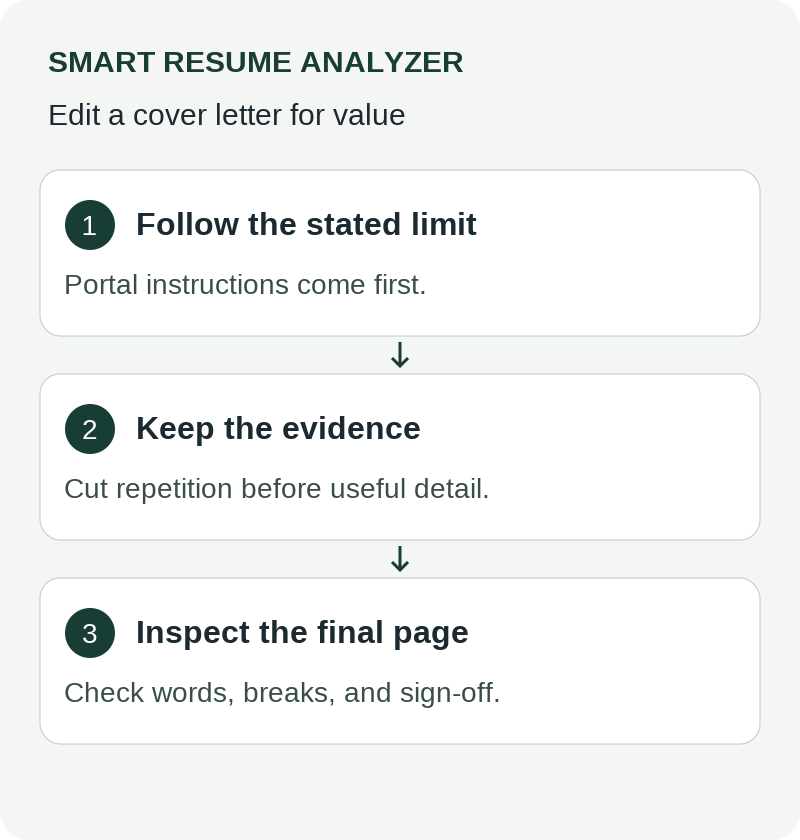
A cover letter should be short enough to read comfortably and long enough to explain the relevant evidence. For an attached job-application letter, one page is a useful default. Employer instructions, portal limits, and the type of application take priority over any generic word target.
Choose a working budget
If no limit is stated, you can start with roughly 250–400 words for the body and shorten it when fewer words do the job. This is an editorial drafting range, not an ATS rule or a measured threshold for getting interviews. A brief email note may be shorter. A program's motivation statement may have entirely different requirements.
| Part | What the words need to do |
|---|---|
| Opening | Identify the position and a relevant connection |
| Evidence | Explain one or two examples that answer the posting |
| Closing | Invite the next step and thank the reader |
Page count also depends on font, margins, address blocks, and spacing. Do not shrink the text until a dense letter technically fits one page.
Trim by removing low-value claims
Consider this fictional sentence: “I am an incredibly hardworking and extremely motivated professional who always goes above and beyond and has exceptional communication abilities.” It takes substantial space while giving the reader little to assess.
A shorter evidence sentence might be: “I wrote the escalation notes used by incoming shift staff to identify the next support owner.” The improvement comes from naming the work, not from swapping long words for short ones.
Cut duplicated resume chronology, repeated enthusiasm, and a summary of the employer's own business. Preserve the example that shows your contribution. If you are explaining a career change, include enough context to make that transition understandable rather than deleting it solely to reach a smaller number.
Count and inspect manually
Select the body in Word or Google Docs and review its word count. If a portal limits characters instead, follow that measurement; spaces and line breaks may count. Paste into the actual field and check for truncation before submitting.
Open the final attachment and look for an isolated sign-off or a second page containing only a few lines. Read aloud once: a repetitive passage is often easier to notice that way. The existing cover-letter generator can supply a draft, but it cannot decide which of your claims are true or which evidence deserves space. Use the review checklist for the final factual pass.
Practical limits that work
A page is a sensible ceiling, which in practice is about 250 to 400 words in three to four paragraphs. If you cannot say it in that space, the letter is probably trying to do the resume's job. A shorter letter is fine when it is specific. Length is not a measure of effort.
When to go shorter or longer
- Shorter: when you are applying through an online form with a text box, or when a recruiter asked for a brief note. Aim for under 200 words and put the strongest link first.
- Longer: rarely. Senior roles or academic applications sometimes expect more detail, and the posting will usually say so.
A quick way to cut
- Delete any sentence that repeats the resume without adding why it matters.
- Delete any adjective you cannot support with an example.
- Merge two similar examples into the stronger one.
- Check that the first paragraph still states the role and the match.
Email versus attachment
If the letter goes in the body of an email, keep it even shorter and make the subject line carry the role and your name. If it is an attachment, use normal margins and spacing so it fits one page without shrinking the font below about 10.5 points.
Draft with the cover letter generator if you want a starting point, then trim it to the budget above. For spacing and layout, see the format guide.
Sources and further reading
Use These Tools Next
Use a working tool to apply this guidance to your own resume or job description.
Related Resume Pages
Explore related keyword and resume guidance pages to keep improving your application materials.
Using this guidance
Use these guides to check a specific part of your application. Automated feedback is guidance, not a hiring prediction. Check suggested edits against your own experience.
Related Articles
Continue with another guide on this topic.
Cover Letters
Cover Letter Format Free: A Simple Guide
Learn the best cover letter format free. Build a clearer, tailored cover letter with simple structure, ATS-friendly writing, and fast editing tips.
Cover Letters
Cover Letter Google Docs Template Guide
Find a cover letter Google Docs template, learn the right structure, and turn a simple draft into a polished application faster.
Job Search Strategy
How to Write a Cover Letter That Doesn't Sound AI-Generated in 2026
Replace generic wording with specific motivation and evidence from your work. Review AI-assisted drafts for accuracy and your own voice.