Letter of Interest Sample: Ask About Future Opportunities
Write a letter of interest when no suitable vacancy is advertised. Includes a fictional sample, a planning checklist, and follow-up boundaries.
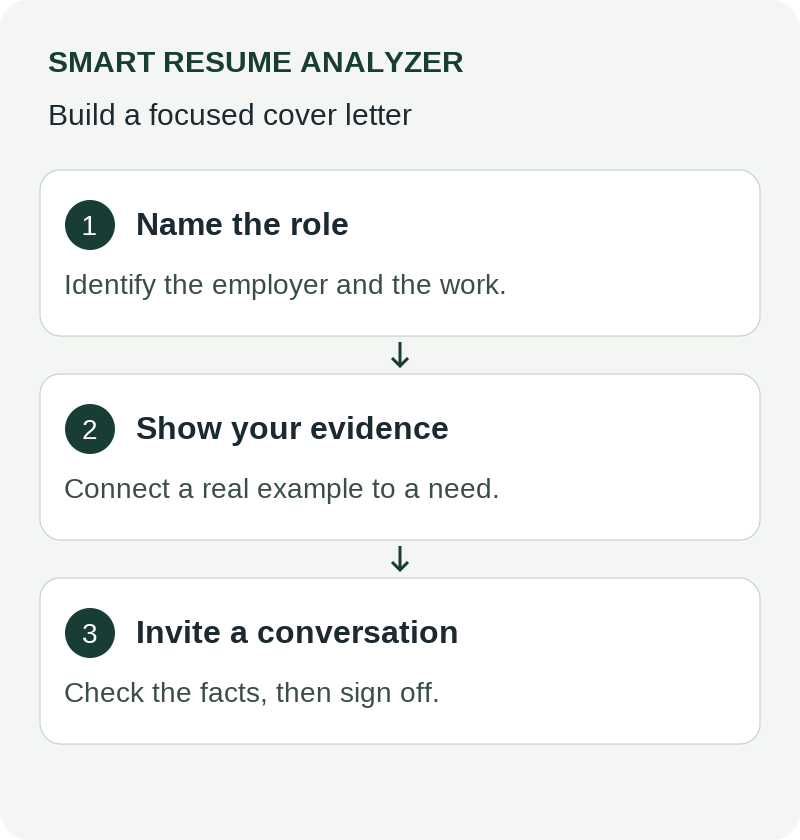
A letter of interest asks an organization about potential opportunities rather than applying to a named vacancy. It can explain the type of work you seek and the experience you could contribute. It does not create an opening or bypass the employer's hiring process.
Check whether this is the right approach
Look for an advertised role first. If one fits, use the requested application process and a role-specific cover letter. If the employer has a talent community or general application form, follow those instructions. Send an unsolicited message only through a suitable public professional contact or a contact who has agreed to hear from you.
Research one real area of the organization's work. Avoid claiming you know its internal problems. “Your public careers page describes a growing customer support function” is more defensible than “Your customer service is struggling.”
Fictional sample
Subject: Interest in support operations opportunities
Dear Support Hiring Team,
I am interested in future support operations positions at Cedar Systems. Your public product documentation emphasizes helping smaller teams manage billing, an area that connects to my experience with account support workflows.
In my current role, I maintain a shared escalation log and work with finance to investigate disputed account charges. I also wrote the onboarding notes our new shift colleagues use to locate the correct support owner.
If you anticipate an opening involving support coordination or documentation, I would welcome information about the appropriate application process. I can share a resume or additional project context if useful.
Thank you for your time, Alex Rivera
This example demonstrates the structure; the employer and applicant are invented. Replace the public reference and evidence with facts, and do not attach sensitive internal documents as proof.
Customize before sending
Name the job family rather than saying you will accept any position. Keep the message short enough that the reader can decide where to route it. Include a contact method, but avoid extra personal identifiers. An optional resume attachment should use a format the recipient can open and should contain only relevant professional information.
If the employer says it accepts applications only through its portal, respect that boundary. If no response arrives, avoid repeated messages to multiple employees. Record the approach separately from applications to advertised vacancies so it does not distort your application response tracking.
What makes a letter of interest different
A letter of interest goes to an organisation that has not advertised a role you want. Because no posting defines the job, your letter has to do that work: it names the kind of role you are looking for, the experience you bring and why this employer. It is a request for a conversation, not an application for a vacancy, and the reader may have no opening at all.
Choosing where to send it
Send it to a person where possible, such as the head of the team you would join, not a general inbox. Read the employer's recent work, projects or published material so you can say something specific about it. A letter that could be sent to any company will be treated as one.
A structure that fits on one page
- A first paragraph naming the area of work you are interested in and why this employer.
- A second paragraph with one or two pieces of relevant experience and what they produced.
- A short closing asking for a brief conversation and giving your availability.
Keep the request modest. Asking for a short call is easier to say yes to than asking for a job.
Follow-up and expectations
Many letters of interest get no reply, because the employer has nothing open. Follow up once after about a week or two, and then move on. Keep a list of where you sent each letter and the date so you do not write twice to the same person.
Attach your resume and check that it reads clearly, using the ATS parser to see how the file extracts. You can also draft the letter with the cover letter generator and edit every line to match your real experience.
A shorter email version
When the contact asked you to write by email, a short message often works better than an attached letter. Keep it to a few lines and make one clear, small request. This fictional example uses placeholders you replace with your own details:
Subject: Question about [team] opportunities
Hello [Name],
I am a [job title] with [number] years of experience in [field], most recently [one specific thing you did]. I admire the [specific project or product] your team has built, and I would like to ask whether [team] expects to hire for [type of role] in the coming months.
I have attached my resume. If it is easier, I would be glad to answer any questions by email.
Thank you for your time, [Your name]
Replace every bracket with true details, mention one real piece of the organization's work, and send it only to a person who has agreed to hear from you or whose role makes the question appropriate.
Sources and further reading
These pages are independent references for the advice in "Letter of Interest Sample: Ask About Future Opportunities". Read them alongside this guide and follow your target employer's own instructions where they differ.
Use These Tools Next
Use a working tool to apply this guidance to your own resume or job description.
Related Resume Pages
Explore related keyword and resume guidance pages to keep improving your application materials.
Using this guidance
Use these guides to check a specific part of your application. Automated feedback is guidance, not a hiring prediction. Check suggested edits against your own experience.
Related Articles
Continue with another guide on this topic.
Cover Letters
Sample CV Letter: How to Write One That Works
Learn what a sample CV letter should include, how to write one, and how to tailor every application with a cover letter builder.
Job Search Strategy
How to Write a Cover Letter That Doesn't Sound AI-Generated in 2026
Replace generic wording with specific motivation and evidence from your work. Review AI-assisted drafts for accuracy and your own voice.
Cover Letters
AI Cover Letter Optimization for IT Applications
Learn how AI cover letter optimization helps IT candidates tailor applications faster with a better **cover letter builder** and resume alignment.